British Accent Text to Speech
Type your text and hear it read by one of 40 native British AI voices — from BBC-style RP to contemporary London, with instant preview and MP3 download.

Listen to Our British AI Voices
Every card plays a real sample — audition the accent before you generate.
A page like this lives or dies on whether the voices actually sound British — not American voices with a costume vowel. The voices below are native en-GB models across three engines — 40 in total: crisp RP narrators built for documentary work, warm everyday reads for e-learning, and brighter contemporary voices for social content. Click any card to hear it, filter by gender, and note the engine tag — it tells you which quality tier the voice lives in.
The engine tag matters more than it looks. The free Basic tier uses neural models that keep the accent authentic for drafts and personal projects; Standard adds HD depth that holds up across long modules; Advanced and Pro are the studio tiers — the ones to audition first for narration, ads, and anything a client will hear. Because every tier shares the same generator, you can draft on the free tier and re-render the final take on Pro without touching the script.
How to Generate a British Voiceover in 3 Steps
Boarding pass to a finished MP3 — under a minute, no account.
Type or paste your text
Drop your script into the generator at the top. Up to 1,000 characters per request works without an account — around 150 words of finished British speech.
Pick a British voice
The voice panel is pre-filtered to the accent — nothing American slips in. Switch engines to trade speed for realism and preview any voice with one click.
Generate and download
Click generate, listen in the built-in player, and download the MP3 — ready for YouTube, audiobooks, e-learning modules, or your phone system.
Small script tweaks help the read: write out abbreviations the first time, prefer shorter sentences for formal narration, and keep UK spellings — the models take pronunciation cues from them. If a proper noun comes out wrong, spelling it phonetically in the text is the quickest fix.
RP, Estuary & Regional British Accents, Explained
"British accent" is really a spectrum — here's where our voices sit on it.

What most tools sell as one British accent is actually a family. At the formal end sits Received Pronunciation (RP) — the "BBC English" of documentaries and period drama. In the middle is Estuary English, the neutral modern sound of London and the South East that most British professionals actually speak. Beyond that lie the regional accents: the musical lilt of Wales, the flat vowels of the North, Scouse in Liverpool, Geordie in Newcastle, and Scottish English with its rolled r.
Where our voices sit on the spectrum
A little history explains the hierarchy. RP became the broadcast standard in the 1920s when the BBC adopted it as its announcing voice, which is why it still reads as 'authoritative' a century later even though fewer than one in ten Britons actually speak it. Estuary rose in the decades after as London's sound spread along the Thames — close enough to RP to feel professional, relaxed enough to feel human. That drift is why modern e-learning and corporate work usually lands in the middle of the spectrum, and why period drama and documentary stay at the formal end.
An honest note on regional accents: like every major TTS library, our en-GB voices sit on the RP-to-contemporary-London spectrum — there are no dedicated Cockney, Scouse, Geordie, or Welsh voice models here yet, and any tool claiming otherwise is usually pitch-shifting a standard voice. If a script needs a strong regional character, voice cloning a native speaker (with their permission) produces a far more convincing result than any synthetic approximation.
British vs American English in Text to Speech
The differences a voice model has to get right — and how to check them.
Switching a script from an American to a British voice changes more than the vowels. British English is non-rhotic — the r at the end of "water" softens away — the a in "can't" and "bath" opens wide, and everyday words split completely: schedule opens with "sh" rather than "sk", garage stresses the first syllable, tomato takes a long ah. A voice model trained on British speakers handles all of this automatically; an American voice reading British spelling does not.
Spelling and formatting follow the accent. If your script says colour, organise, £49.99, or 08/07/2026 meaning the 8th of July, the en-GB voices read them the way a UK listener expects. Generate the same sentence with a British and an American voice below and the gap is obvious in the first line.
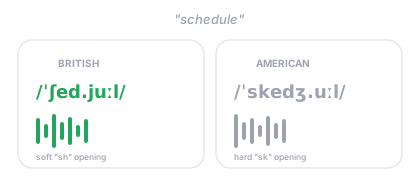
| Word | British 🇬🇧 | American 🇺🇸 |
|---|---|---|
| schedule | /ˈʃed.juːl/ — "shed-yool" | /ˈskedʒ.uːl/ — "sked-jool" |
| tomato | /təˈmɑː.təʊ/ — long ah | /təˈmeɪ.t̬oʊ/ — "may" |
| water | /ˈwɔː.tə/ — soft ending | /ˈwɑː.t̬ɚ/ — hard r |
| garage | /ˈɡær.ɑːʒ/ — first-syllable stress | /ɡəˈrɑːʒ/ — second-syllable stress |
| spelling | colour · organise · centre | color · organize · center |
| formats | £ · DD/MM/YYYY | $ · MM/DD/YYYY |
Beyond individual words, the melody differs. UK speech tends to fall at the end of statements where American speech often stays level, questions rise more sharply, and stress lands earlier in many longer words. These patterns are baked into the voice models rather than bolted on — which is why the same sentence, generated twice below, sounds like two different speakers and not one speaker doing an impression.
Samples play each voice's standard preview clip — generate your own sentence above to compare them on your exact script.
What Creators Make with British Voices
Seven jobs where a British accent isn't decoration — it's the brief.
These aren't interchangeable jobs where any narrator would do. In each of the seven, the accent itself does work — signalling authority, matching an audience's expectations, or localising details like currency and dates that a mismatched narrator reads wrongly. That's the practical test for whether this page is the right tool: if swapping the accent would change how the audience receives the content, it belongs here.
Audiobooks & classic fiction
Austen, Dickens, detective novels — listeners expect British narration for British stories. A steady RP voice carries chapters without fatigue.
Documentary narration
The "BBC English" association is real: RP reads test as more authoritative for factual content, which is why it remains the documentary default.
YouTube & explainers
The accent makes a channel instantly distinctive in a feed full of American narration — and generates in seconds when scripts change.
Luxury & brand ads
Premium brands lean on British reads for the polish association. Test five takes of the same line before a single media dollar is spent.
UK e-learning & training
British spelling read correctly, £ and dates formatted as UK learners expect — localisation that American voices quietly get wrong.
UK business phone lines
IVR menus and appointment reminders in the accent your British customers speak — generated per prompt, updated the day the menu changes.
IELTS & pronunciation practice
Paste any sentence and hear standard British pronunciation on demand — listening practice that matches the accent of the actual exam.
Why AnySpeech for British Text to Speech
Most tools give you one engine's idea of a British voice. Here the accent comes in three quality tiers: the free Basic engine covers drafts and personal use with genuine en-GB neural voices, the Standard engine adds HD depth for long narration, and the Advanced and Pro engines deliver the studio-grade British reads used in the samples above. Same text box, one click to switch.
Credits work the same way as everywhere else on AnySpeech: the Basic tier is free forever, Standard and Advanced cost one credit per character, Pro costs two. For a typical 60-second read of about 150 words, that's under a thousand credits on the studio tier — the free monthly allowance on any paid plan covers hours of finished audio, and drafting on the free tier costs nothing at all.
British voices on the free tier, no account, 10 conversions a day with MP3 download included.
Audition the same script across quality tiers and pay only for the tier the project needs.
Need a specific regional character? Clone your own voice — or a consenting native speaker's — from a 30-second sample.
Frequently Asked Questions
Explore More Accents & Languages
Every entry links to a dedicated text to speech page.
This page is part of a growing atlas: every language below has its own dedicated generator page with native voices, and more accent pages are on the way. If your audience spans regions, bookmark the hub — one workflow covers every market on the map.